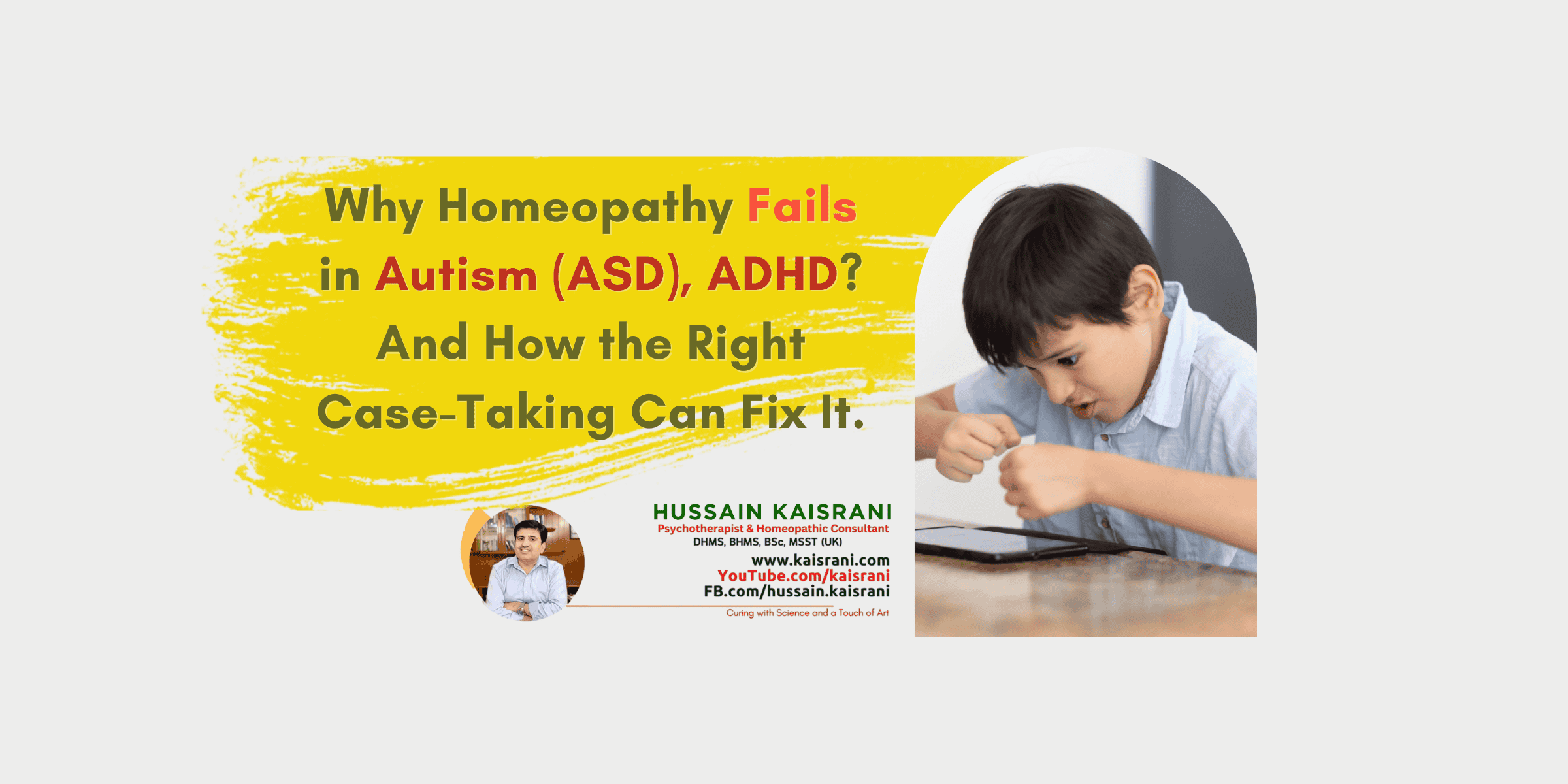
A practical, experience-based explanation of why conventional homeopathic methods fall short in Autism Spectrum Disorder – and how structured, intelligent case-taking transforms outcomes.
By Dr Hussain Kaisrani, Psychotherapist & Homeopathic Consultant (DHMS, BHMS, BSc, MS (UK))
Why This Topic? Why Case-Taking in Autism Matters
I chose this topic because case-taking for autism is fundamentally different from ordinary case-taking. Through many years of clinical experience – including repeated failures – I realised that treating autistic, ADHD, or ODD children requires a completely different mindset. The traditional homeopathic approach is often inadequate for neurodivergent cases.
Even with careful observation, correct rubrics, and deep analysis, we saw results fall short. The same pattern was reported by many homeopathic practitioners I worked with. Eventually, it became clear:
We needed a new lens – a different “eye” – to understand these children.
What we ask, how we ask and what we observe are all critically important.
Understanding Autism Spectrum Disorder (ASD)
Autism is a spectrum, ranging from very mild to very severe. A child attending a mainstream school may still struggle significantly. He might fail to understand basic social cues – speaking when others have lost interest, laughing at inappropriate moments, or missing emotional signals. These subtleties are part of the spectrum.
The standard clinical reference, the DSM-5, outlines the core areas of Autism Spectrum Disorder:
1. Social Communication Difficulties
- Limited or inconsistent eye contact
- Difficulty developing or maintaining friendships
- Lack of appropriate facial expressions
- Challenges in basic two-way communication
2. Restricted Interests & Repetitive Behaviours
- Stimming such as hand-flapping or visual fixation
- Echolalia, repeating phrases or words
- Sensory sensitivities, including extreme responses to sound, touch, smell, or food textures
- Rigid routines, distress when routines change
- Obsessive engagement with objects, parts of objects or specific topics
3. Early Developmental Onset
Symptoms are typically present from early childhood, though the severity may become more noticeable as demands increase.
4. Functional Impairment
Symptoms affect social, academic, emotional, or everyday functioning.
Common Symptoms Reported by Parents
Parents often describe patterns like:
- Delay in speech or motor development
- Lack of interest in peers
- Hyperactivity, toe-walking, hand-flapping
- Disturbed sleep or unusual eating habits
- Anxiety, phobias, social withdrawal
- In some cases, associated conditions such as epilepsy
These observations help build the full picture during case-taking.
Possible Causes & The Post-COVID Surge
Many parents ask: “Why my child?”
The answer isn’t simple. Contributing factors can include genetics, family history, maternal age, or prenatal stress.
However, in my clinical experience, one modern factor stands out – and has surged dramatically post-COVID:
Excessive and early screen exposure.
I have had parents honestly share that their child was exposed to 8–10 hours of screen time daily, sometimes from infancy. While some parents suspect vaccination triggers, my experience points strongly towards:
- Prenatal emotional stress
- Genetic susceptibility
- Abnormal and prolonged screen exposure, especially during early developmental years
Screens may not cause autism, but they can exacerbate symptoms, delay speech, reduce social interaction, and worsen behavioural patterns.
The Homeopathic Perspective: Why Case-Taking Must Evolve
In homeopathy, a well-taken case is half the cure. This is even more true for neurodivergent children (ASD, ADHD, ODD), where superficial details simply do not reveal the remedy.
This is why I use a specialised, highly structured pre-consultation history form, carefully adapted over years of treating hundreds of cases.
Why Use a Form?
- It prevents unnecessarily long interviews that drain the child and the parents
- It allows parents to reflect deeply and give honest, detailed information
- It clarifies the homeopathic process, expectations, and procedures
- It captures vital behavioural, emotional, and developmental data that cannot be gathered in a short sitting
What the Form Covers
- Chief Complaints: e.g., “stares at fans,” “delayed speech,” “hand-flapping,” “no response to name”
- Associated Complaints: constipation, recurrent infections
- Temperament & Emotional Profile: fears, anger, sensitivities, interaction with family
- Tantrum Pattern: triggers, duration, calming method
- General Symptoms: sleep, appetite, cravings, thermals, thirst
- Past History: pregnancy stress, delivery details, vaccinations, milestones
- Family History: genetics, psychological conditions, neurological issues
- Assessments: speech reports, behavioural evaluations, EEGs, psychological testing
This structured approach enables the homeopath to see the entire child, not just the symptoms. Often, the form reveals the remedy even before the consultation begins.
Autism vs OCD — A Clear Distinction
Some children may appear obsessive or repetitive, and parents sometimes confuse this with OCD. However:
- OCD is driven by intrusive, anxiety-creating thoughts.
- Autism involves repetitive behaviours due to sensory needs, comfort or routine-based rigidity.
Autism does not typically involve the intrusive thoughts that characterise OCD. Understanding the difference is essential during case-taking.
About Dr Hussain Kaisrani
Dr Hussain Kaisrani is an experienced Psychotherapist and Homeopathic Consultant (DHMS, BHMS, BSc, MS (UK)) with over two decades of practice. He specialises in a unique, integrative approach to treating neurodivergent children; including Autism Spectrum Disorder (ASD), ADHD and Oppositional Defiant Disorder (ODD).
His method emphasises precise, empathetic, highly structured case-taking, enabling more accurate remedy selection and better support for families navigating autism.
Website: www.kaisrani.com
YouTube: youtube.com/kaisrani